Correct answer
A Echocardiogram
Pericardial tamponade is a rare complication of central venous catheter insertion. In this patient, the dilations of the stricture at the level of the superior vena cava (SVC) led to a full thickness disruption and bleeding into the pericardium. An urgent echocardiogram will identify fluid in the pericardium and prompt pericardiocentesis with drain placement is lifesaving.
The pericardium is composed of an inner serous and an outer fibrous layer. The pericardium extends superiorly along the external surface of the great vessels for 2-3 cm. Significant scarring of the SVC can result from multiple previous catheters increasing the risk of catheter placement. If central venous stenosis is suspected preoperatively, a MRV may be helpful to evaluate for the presence and severity of the scarring. Often this diagnosis is encountered intraoperatively with difficulty passing the wire centrally and use of an angled or straight glidewire is required to traverse this scarred area. Even with careful dilation with a balloon or serial vascular dilators, transmural disruption of the scar tissue and bleeding into the pericardium may occur, as seen in this case. This complication has been reported more frequently in the interventional radiology literature and pediatric surgeons must be aware of this complication given the increasing complexity of patients requiring central venous catheter placement.
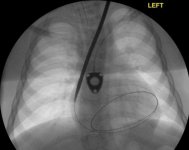
In this case, the fluoroscopic image clearly shows the dilator in good position and no evidence of a hemo/pneumothorax. Thus, placement of a chest tube or performing thoracotomy/sternotomy are not indicated. Once the pericardial effusion is adequately drained and the patient stabilized, the patient could proceed to interventional radiology for a formal venogram and balloon tamponade (compression at the leak site) if active extravasation into the pericardial space is identified. If interventional radiology is not an option, then the patient should remain in the OR and carefully monitored. If there is ongoing output from the pericardial drain and/or the patient is hemodynamically unstable, then surgical intervention is required.