• Welcome to Pediatric Surgery Club! If this is your first visit, please sign up to get the best experience sign up!

weekly question 6/11/2022

.US site, click here!

Admin

Administrator
Staff member
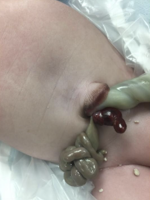
A 36-week female infant with gastroschisis has just arrived in the neonatal intensive care unit. The appearance is shown below.
Screenshot 2022-11-06 at 16.24.10.png


The most appropriate operative management of this infant is which of the following?

A Ostomy creation

B Enlargement of the defect

C Sutureless closure

D Excision with primary anastomosis

E Placement of the bowel in a silo​
 
correct answer
B Enlargement of the defect

Closed (aka vanishing or closing) gastroschisis is a rare clinical entity that results from closing of the umbilical ring around herniated bowel contents. This clinical entity has been historically described as having a high morbidity and mortality in this infant population. New studies have shown that there has been improved long-term survival. There is a recognition that this is a spectrum of disease with different severity based on the condition of the external bowel. The majority of the morbidity from closed gastroschisis is secondary to subsequent short gut syndrome and need for long term parenteral nutrition. The key to the operative management of these infants is to preserve as much intestinal length as possible after accounting for any frankly necrotic bowel that needs to be excised. After enlargement of the fascial ring the external bowel should be reduced with a plan for return exploration in 6-8 weeks. Often external tissue that is fused without distinctly identifiable bowel loops can lead to subsequent viable bowel.
 
Back
Top