Correct answer
a Hair Tourniquet Syndrome
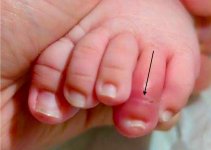
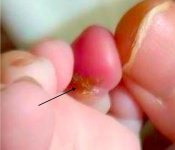
Hair-Tourniquet Syndrome, also called Hair-Thread Tourniquet Syndrome, is a rare condition in which a strand of hair (or similar material) circumferentially constricts a bodily appendage. This hair eventually leads to strangulation of the appendage due to impairment in both arterial inflow as well as venous return. The toes and fingers are the most commonly affected sites, but others, such as the uvula and penis, have also been reported. If left untreated, the affected site can continue to worsen and lead to tissue necrosis, gangrene and even auto-amptuation. Treatment consists of removing the offending hair as quickly as possible. If the entire hair can’t be removed, then one or more longitudinal incisions through it may be sufficient to release the constriction of the appendage. Some authors have reported the successful use of topical depilatory creams, while others have advocated for physical removal of the hair (either in clinic or in the OR). In many cases, the affected appendage may recover once the constricting hair has been removed. However, viability of the appendage is based on the degree of tissue damage for each individual patient.
Milroy’s Disease is an inherited autosomal dominant condition characterized by bilateral lower-limb swelling, typically present at birth, or develops shortly thereafter, and most commonly affects the dorsum of the feet in neonates. It does not typically present in individual toes. Macrodactyly is characterized by one or more toes or fingers that are abnormally large due to underlying bone and soft tissue growth. However, the affected appendage typically is not red and should not display an area of circumferential indentation. Ingrown toenails can cause erythema and swelling in infants. However, such signs of inflammation should always begin from one side of the nail bed. Drainage of pus is also seen in severe cases. Klippel-Trenaunay syndrome is a rare condition resulting from an error in development of the blood vessels and lymphatic channels in one or more limbs. Patients usually display well demarcated port-wine stains, varicose veins, lymphedema and hypertrophy of the affected limb. It typically does not present in individual fingers or toes.