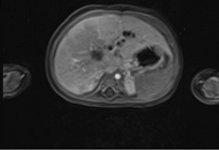
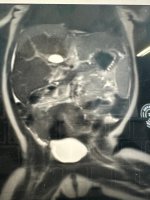
correct answer
d Bile lakes
Bile lakes are intrahepatic bile collections that develop in about 6-24% of patients with biliary atresia. They may be simple, multiple, or have bead-like patterns. Bile lakes are thought to be an extension of the inflammatory nature of biliary atresia. Bile lakes have been associated with increased incidence of cholangitis, with greater association seen in the multiple and bead-like configurations. It is uncertain whether cholangitis or bile lakes is the inciting factor for the development of the other.
When bile lakes are seen during episodes of cholangitis, treatment starts with antibiotics. More aggressive intervention such as percutaneous bile drainage or surgical management has been described but the desired effects of lesion resolution and better function of the native liver is not uniform. Bile lakes may resolve on their own as well. Therefore, its mere presence is not an indication for aggressive intervention
Gohda et. al. has identified that bile lakes confer a much higher risk of eventual liver transplantation beyond one year of age, even in patients with normal biliary drainage.