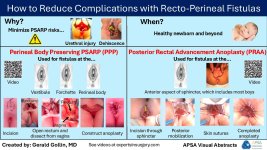
A full-term newborn boy is found to have a recto-perineal fistula located at the anterior aspect of the sphincter complex seen below, The strategy most likely to reduce the risk for postoperative perineal dehiscence is

a Discharge with daily fistula dilations and minimal posterior sagittal anorectoplasty (PSARP) at 6 months of age
b Perineal body preserving posterior sagittal anorectoplasty (PPP)
c Posterior rectal advancement anoplasty (PRAA) before discharge
d End-descending colostomy with minimal posterior sagittal anorectoplasty (PSARP) at 6 months
e Minimal posterior sagittal anorectoplasty (PSARP) before discharge
a Discharge with daily fistula dilations and minimal posterior sagittal anorectoplasty (PSARP) at 6 months of age
b Perineal body preserving posterior sagittal anorectoplasty (PPP)
c Posterior rectal advancement anoplasty (PRAA) before discharge
d End-descending colostomy with minimal posterior sagittal anorectoplasty (PSARP) at 6 months
e Minimal posterior sagittal anorectoplasty (PSARP) before discharge