

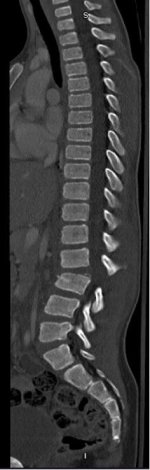
A 10-year-old is involved in a high speed motor vehicle collision. They were appropriately restrained with a seatbelt. On physical exam, there is a visible seatbelt sign, mild lower abdominal pain and no neurologic deficits. Their CT scan (image included) shows a comminuted fracture of L2 vertebral body, widening of the L1/L2 interspace with subluxation and perched facet of L2 on L1. Additional findings include a grade 2 splenic injury and a small amount of free intra-abdominal fluid. Neurosurgery wants to repair the spine injuries after admission, however, on the morning of scheduled repair with neurosurgery, the patient has a fever to 103℉, worsening abdominal pain, and tachycardia. What is the best next step in the management of this patient?
a Diagnostic laparoscopy/laparotomy
b Proceed with neurosurgical repair of the spine injury
c Transfuse 20 ml/kg of packed red blood cells
d Repeat abdominal CT scan
e Broad spectrum antibiotics
a Diagnostic laparoscopy/laparotomy
b Proceed with neurosurgical repair of the spine injury
c Transfuse 20 ml/kg of packed red blood cells
d Repeat abdominal CT scan
e Broad spectrum antibiotics


