Correct answer
D Treatment with a biologic agent
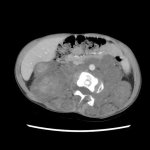
Historically, surgical treatment was the mainstay of management for symptomatic neurofibromas in neurofibromatosis 1 (NF1). However, in advanced cases such as this, surgical treatment would involve sacrificing critical structures and is not possible without significant morbidity. These lesions do not respond well to either conventional chemotherapy or radiotherapy. In patients with NF1, dysfunction of the guanosine triphosphatase–activating protein, neurofibromin, leads to overactivation of the RAS pathway. Targeted inhibition of the RAS pathway with mitogen-activated protein kinase (MEK) inhibition is the basis for the biologic treatment of this condition. In 2020, the FDA approved selumetinib, an MEK inhibitor, for treatment of inoperable neurofibromas. In clinical trials, durable (greater than one year) response rates of 60-70% were seen both clinically and radiographically in children with this disease. Immunotherapy is not a proven treatment for inoperable neurofibromas in children with NF1.