• Welcome to Pediatric Surgery Club! If this is your first visit, please sign up to get the best experience sign up!

weekly question 16/11/2025

.US site, click here!

Admin

Administrator
Staff member
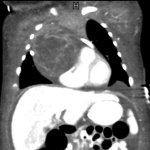
A term female infant born with APGARs of 2, 5, and 7 was apneic at delivery. After intubation, CXR demonstrated an abnormal mediastinum. Cardiac echo revealed a large mass in the pericardial space and a large pericardial effusion with decreased systemic venous return. What is the best next step in this infant’s management?

a Obtain tumor markers

b Thoracoscopic resection

c Place pericardial drain

d Obtain cross sectional imaging
 
correct answer
c Place pericardial drain

This infant is in urgent need of stabilization and placement of a pericardial drain will likely improve the baby’s hemodynamic status. The echo findings are concerning for a mediastinal teratoma or germ cell tumor. Once stabilized, investigation with cross-sectional imagining and evaluation of tumor markers including alpha-fetoprotein and beta-HCG. Elevations in beta-HCG and alpha fetoprotein may indicate malignancy and these markers can serve as a means to follow the child for tumor recurrence if positive.

In the neonatal age group, teratomas are most commonly benign. The sacrococcygeal area is the most common location for neonatal teratomas followed by the anterior mediastinum.

Approaching an intrapericardial lesion would be difficult utilizing a thoracoscopic approach. In fact, many surgeons would advocate for approaching these tumors through a median sternotomy. These tumors may be adherent to structures in the anterior mediastinum or pericardium that may necessitate rapid institution of cardiopulmonary bypass, which would be facilitated by already having exposure to the heart and aorta. Complete surgical excision of the mass is necessary, since most of these lesions are benign and therefore will not respond to chemotherapy.

repview.thumb.png.2a212284ed14cd3c0004348d93056216.jpg
 
Back
Top