Correct answer
a Diverting ostomy
The management of Hirschsprung disease has continued to evolve since Ovar Swenson first recognized that aganglionosis was the cause of the obstruction and devised an operation to remove the affected segment. The majority of children who undergo operative repair have favorable outcomes. However, a subset of children will continue to have difficulty even in the setting of a well performed operation. This has led to development of systematic approaches for the management of children who are having difficulty postoperatively depending upon whether they exhibit obstructive symptoms, incontinence or recurrent episodes of Hirschsprung associated enterocolitis (HAEC).
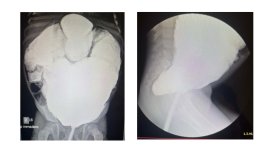
The Duhamel procedure brings along with it unique opportunities for obstructing pathology due to the retained distal aganglionic segment. The procedure involves bringing the ganglionic segment of bowel posterior to the aganglionic segment of rectum and creating a side-to-side anastomosis between the two. This can result in the creation of a “spur” if the anastomosis does not incorporate the entire aganglionic segment. This can ultimately dilate and be a source of obstruction through external compression. Diagnosis is made via endoscopy or contrast enema that shows the spur. The treatment is either incorporation of the spur by extending the anastomosis or resection of the spur.
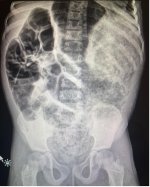
The other complication associated with the Duhamel procedure is a “mega pouch” which is the situation with this patient. One study of 17 patients with complications following a Duhamel procedure found this to be the most common complication. Treatment of this typically requires resection and a revision pull-through. While these patients may initially be managed with rectal irrigations and disimpaction, the dilation of the mega pouch tends to be progressive and ultimately will lead to a fibrotic pouch that will eventually require re-do pull-through. The revision procedure typically requires a combined abdominal and transanal or posterior sagittal approach given the extent of the fibrosis and dilation. Temporary diversion should be considered especially in the setting of a marked dilated bowel proximal to the Duhamel pouch to allow for decompression ultimately allowing for the bowel to be used for subsequent pull-through. In this case there is marked dilation of bowel in the setting of a child who is expected to be malnourished due to the chronicity of her disease. A temporary diverting ostomy will allow for decompression of the dilated bowel and improved nutritional status prior to proceeding with resection of the Duhamel pouch and ultimate revision of the pull-through.