correct answer
a ultrasound.
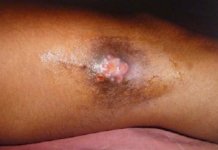
Ultrasound (US) examination for nonradiolucent soft tissue foreign bodies such as wood is very accurate (sensitivity and specificity greater than 90%). In this case US revealed a single foreign body measuring 7 cm long and 0.5 cm wide which was successfully extracted surgically.
Ultrasound can be used intraoperatively to assist the surgeon in identifying the foreign body and to document complete extraction of foreign body after the procedure.
Magnetic resonance imaging and computerized tomography have been used to evaluate leg soft tissue masses and wounds. Because of expense and radiation, if a wooden foreign body is suspected these would not be the appropriate next imaging modality. A bone scan might be helpful to evaluated for osteomyelitis which was not highly suspected in this case and a PET scan would not be an appropriate modality for suspected foreign body.
There are a number of case reports and small series published regarding deep retained wooden foreign bodies often describing impaling injuries by tree branches, tooth picks, chopsticks and wooden utensils. These retained wooden objects can result in soft tissue masses concerning for tumor or can develop draining sinuses and serious deep soft tissue infections including necrotizing fasciitis. Staphylococcus aureus and various fungi are often reported from wound culture.