• Welcome to Pediatric Surgery Club! If this is your first visit, please sign up to get the best experience sign up!

weekly question 19/10/2025

.US site, click here!

Admin

Administrator
Staff member
A 2-day-old infant is in the newborn nursery with persistent nonbilious emesis and intolerance of feeds. A chest radiograph was obtained which is shown below. Based upon this imaging an upper GI study was obtained showing no progression of contrast beyond the stomach after 1 hour (below). What is the most commonly reported condition associated with this diagnosis?
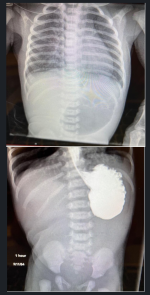
2025-10-19_16-21-39.png


a Ventricular septal defect

b Vertebral anomalies

c Renal agenesis

d Epidermolysis bullosa

e Intestinal atresia
 
A 2-day-old infant is in the newborn nursery with persistent nonbilious emesis and intolerance of feeds. A chest radiograph was obtained which is shown below. Based upon this imaging an upper GI study was obtained showing no progression of contrast beyond the stomach after 1 hour (below). What is the most commonly reported condition associated with this diagnosis?

View attachment 15026


a Ventricular septal defect

b Vertebral anomalies

c Renal agenesis

d Epidermolysis bullosa

e Intestinal atresia
e
 
correct answer
d Epidermolysis bullosa

Pyloric atresia is a rare disease entity first described by Calder in 1749. It occurs in approximately 1:100,000 live births and makes up about 1% of all gastrointestinal atresias. It was not until 1940 that the first successful repair was documented. There are three common variations reported:

  • Type 1: Pyloric membrane or web
  • Type 2: Solid cord of the pyloric channel
  • Type 3: Gap between stomach and duodenum
Depending upon the anatomic variant, a Heineke-Mikulicz pyloroplasty or gastroduodenostomy have been described as the surgical repair.

Literature on pyloric atresia tends to be limited to case series due to the rarity of this condition with a recent series only reporting 20 cases over a 22 year period at a single institution. Polyhydramnios may be seen prenatally but is a nonspecific finding, and most infants are not definitively diagnosed until after birth. Associated anomalies are not uncommon and are reported to occur with a frequency of 30 to 65%. The most commonly reported associated anomaly is epidermolysis bullosa. The second most frequently reported anomalies are intestinal atresias that may occur anywhere along the GI tract including the esophagus. Other reported associated anomalies include Trisomy 21 and congenital heart disease.

Epidermolysis bullosa itself is a rare genetic skin disorder that is classified by bullous formation due to mechanical trauma. It is divided into three subtypes: epidermolysis bullosa simplex, junctional epidermolysis bullosa, and dystrophic epidermolysis bullosa. All three of these subtypes have been associated with pyloric atresia. Due to the frequent association it is felt that this is a distinct clinical entity and has been defined as Congenital Pyloric Atresia – Epidermolysis Bullosa (CPA-EB) syndrome. Children presenting with this syndrome have been reported to have a dismal prognosis due to the severe electrolyte imbalances and infectious risks seen with EB. Previously felt to be a uniformly fatal diagnosis, new treatments for EB have improved survival rates and the association of CPA-EB should not preclude surgical management.
 
Back
Top