• Welcome to Pediatric Surgery Club! If this is your first visit, please sign up to get the best experience sign up!

weekly question 28/9/2025

.US site, click here!

Admin

Administrator
Staff member
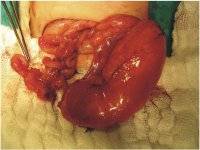
You explore a 3.6 kg, 36 week old male infant with concern for intestinal atresia. At the time of the operation, you discover a Type IIIb jejunal atresia as noted in the below picture. There is only 30 cm of well-perfused bowel proximal dilated bowel prior to the atretic segment. This proximal bowel is dilated up to 5 cm from the ligament of Treitz. The most appropriate management of the dilated proximal bowel is:
repview.jpg

a Resect the dilated bowel

b Perform end jejunostomy

c Perform a tapering enteroplasty followed by anastomosis

d Leave the child in discontinuity and manage with TPN

e Perform a neonatal STEP procedure
 
You explore a 3.6 kg, 36 week old male infant with concern for intestinal atresia. At the time of the operation, you discover a Type IIIb jejunal atresia as noted in the below picture. There is only 30 cm of well-perfused bowel proximal dilated bowel prior to the atretic segment. This proximal bowel is dilated up to 5 cm from the ligament of Treitz. The most appropriate management of the dilated proximal bowel is:

View attachment 15023

a Resect the dilated bowel

b Perform end jejunostomy

c Perform a tapering enteroplasty followed by anastomosis

d Leave the child in discontinuity and manage with TPN

e Perform a neonatal STEP procedure
C
 
correct answer
c Perform a tapering enteroplasty followed by anastomosis


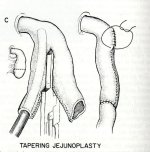
Type III b atresia may present with significant loss of intestinal length leaving the infant at risk for short bowel syndrome. In these cases, preservation of intestinal length and mucosal absorptive surface area is critical. Options for management of this dilated proximal bowel include tapering, imbrication, and a neonatal STEP though the latter is controversial and the supporting data in unclear. Tapering is performed by opening the distal end of the proximal dilated bowel, inserting a red rubber catheter (20 t0 24 French) and using a stapler to resect bowel on the antimesenteric side back to where the intestinal caliber is more normal. (Figure) There are prior reports of intestinal imbrication where the antimesenteric side is folded inward and then sewn together. This decreases luminal diameter but tends to become undone over time resulting in recurrent dilation. Primary neonatal serial transverse enteroplasty (STEP) has also been described but the numbers are small and long term outcomes are unclear.


repview(1).thumb.png.b9a59bb38c6746dd47da59ca32b15bfb.jpg
 
Back
Top