Correct answer
B Excision of the entire lesion
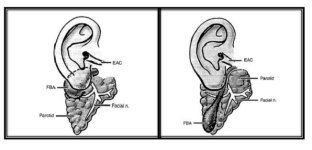
This patient presents with a first branchial cleft lesion. First branchial cleft anomalies can occur anywhere along the course of the first branchial arch tract. This area extends from a cutaneous opening in the submandibular triangle, superio-lateral to the hyoid bone, ascending to the region of the parotid gland, and terminating in the external auditory canal.
Two types of first branchial anomalies have been described.
Type I anomalies are cystic masses adjacent to the external auditory canal. These lesions are purely ectodermal in origin and are duplications of the membranous external auditory canal. These may present as a painless or inflammatory mass in the parotid region.
Type II anomalies may present as cysts, sinuses, or fistulae in the region of the angle of the mandible. Type II lesions are both ectodermal and mesodermal in origin and may contain squamous epithelium, skin adnexa, and cartilage. These lesions may present with intermittent drainage of mucus or pus from the external auditory canal or from a pit at angle of the mandible.
Branchial anomalies that present with cellulitis or abscess should be treated with a course of antibiotics. If an abscess is present, aspiration is preferred over incision and drainage along with an appropriate oral/IV antibiotic course. Once the inflammation subsides, definitive resection can be performed. In this case, there are no signs of infection and definitive resection may be scheduled.