• Welcome to Pediatric Surgery Club! If this is your first visit, please sign up to get the best experience sign up!

weekly question 12/4/2026

.US site, click here!

Admin

Administrator
Staff member
A 5-year-old child underwent a Yancey-Soave pull through for Hirschsprung disease as a newborn. They present to your office due to concerns about infrequent stools and abdominal distension. A thorough workup reveals no twist, stricture, or retained cuff. There are circumferential ganglion cells at the anastomosis. What is the next best step in management?

a Injection of botulinum toxin into the internal sphincter.

b Revision of the pull through.

c Biofeedback therapy.

d Twice daily dilations.

e Lateral internal anal sphincterotomy.
 
A 5-year-old child underwent a Yancey-Soave pull through for Hirschsprung disease as a newborn. They present to your office due to concerns about infrequent stools and abdominal distension. A thorough workup reveals no twist, stricture, or retained cuff. There are circumferential ganglion cells at the anastomosis. What is the next best step in management?

a Injection of botulinum toxin into the internal sphincter.

b Revision of the pull through.

c Biofeedback therapy.

d Twice daily dilations.

e Lateral internal anal sphincterotomy.
A
 
correct answer
a Injection of botulinum toxin into the internal sphincter.

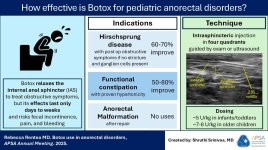
Botulinum toxin works by temporarily inhibiting acetylcholine release at the neuromuscular junction, resulting in chemical denervation and relaxation of the internal anal sphincter. In children with Hirschsprung disease, obstructive symptoms after pull through are frequently due to internal anal sphincter hypertonicity and botulinum toxin can directly address this problem. Studies, including a 2019 meta-analysis by Roorda and a 2022 prospective cohort by Baaleman, et al., demonstrated that approximately 60-70% of Hirschsprung patients experience improvement in stooling and obstructive symptoms after injection. The effect typically lasts three to six months and repeat injections may be required.

A revision of the operation would not be appropriate as there are circumferential ganglion cells.

Dilations might be helpful in the context of an anastomotic stricture but this is not the case here. Lateral internal sphincterotomy and biofeedback have not been described as effective in this situation.

repview(5).jpeg.bb404380636ae59c74a7d8cf1b87fafa.jpeg
 
Back
Top